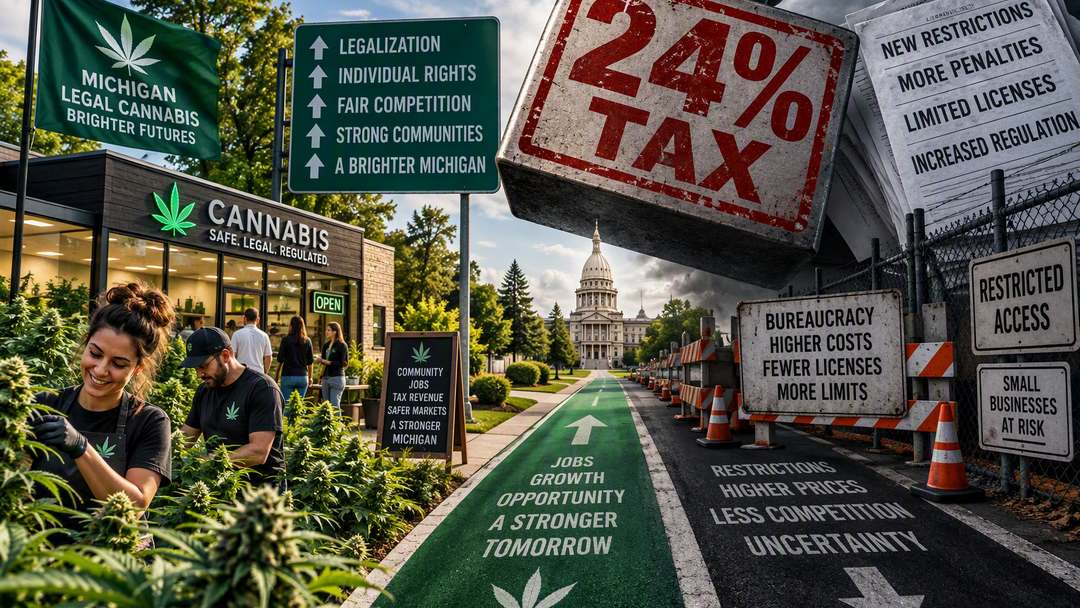
Michigan’s 24% wholesale cannabis tax is about more than just being a really bad idea. For cannabis reform advocates, it is a clear example of a larger problem. Michigan voters repeatedly chose to move cannabis policy toward legalization, individual rights, and a regulated commercial market, while Lansing increasingly seems interested in moving parts of that system in the exact opposite direction.
Voters approved medical cannabis in 2008 and adult-use legalization through MRTMA in 2018. MRTMA established legal possession, home cultivation, commercial licensing, and a 10% excise tax. It also came with the constitutional protection normally afforded voter-initiated laws: Article II, Section 9 generally requires a three-fourths vote of both legislative chambers to amend or repeal them. Yet the new 24% wholesale tax passed the Senate only 19-17 because lawmakers enacted it through a separate road-funding statute rather than directly amending MRTMA. The state says that makes it a separate tax, while industry challengers argue lawmakers effectively changed the voter-approved system without the constitutionally required supermajority. The courts are now sorting that out.
The frustration is compounded by the fact that cannabis was already helping pay for Michigan’s roads. MRTMA directs part of its tax revenue to transportation, and cannabis has contributed well over $100 million to Michigan transportation. Yet when Lansing wanted still more road money, the answer was another enormous cannabis tax. Industry advocates warned that doing so would place additional costs on businesses already dealing with severe price compression and thin margins. Nevertheless, the Governor proposed the tax, and lawmakers from both parties ultimately supported the 24% version.
The tax also fits into a broader legislative trend that concerns reform advocates. Senate Bill 597 would limit new adult-use retailer licenses to generally no more than one retailer for every 5,000 residents in a municipality; notably, the Senate Fiscal Agency itself warned that the proposal could create regional monopolies or oligopolies and particularly affect smaller communities. House Bill 5757 would cut the number of plants a registered caregiver may cultivate for each patient from 12 to 6 and limit caregiver registrations at a single address. House Bills 5105 and 5107 would also rewrite cannabis possession and penalty provisions. Supporters argue that the bills are intended to create clearer, graduated penalties and give authorities better tools against large unlicensed commercial operations. However, Michigan should be extremely cautious about rebuilding criminal penalties around conduct in an area where voters explicitly chose legalization and reduced punishment. Both bills advanced from committee in May 2026.
From the reform perspective, Michigan’s starting point should be simple because if lawmakers are going to reopen voter-approved cannabis laws, the goal should generally be to make the system broader, fairer, and easier to navigate, not more restrictive. Legal businesses already deal with licensing costs, taxes, testing, tracking, local regulation, and extensive state rules. The obvious alternative to continually increasing enforcement is to reduce unnecessary regulation, lower avoidable costs, and make compliance easier for operators.
The same principle applies to individuals. Michigan voters did not legalize cannabis so lawmakers could spend the following years searching for new ways to narrow possession, cultivation, or medical rights without a demonstrated public need. Nor did voters create a commercial cannabis market so the state could artificially restrict competition simply because existing operators are struggling.
There can be legitimate reasons to update cannabis laws, and each proposal should be judged on its actual language and evidence. But cannabis advocates are also justified in asking lawmakers to demonstrate the problem before taking away rights, limiting licenses, increasing penalties, or adding another regulatory burden.
That is what makes the 24% tax such an important symbol of the larger debate. Cannabis was already regulated, already taxed, and already contributing to road funding. The industry warned about the consequences of adding another major cost. Yet somehow the bipartisan answer was still to squeeze cannabis harder.
Michigan voters spent years moving cannabis policy away from prohibition and excessive government interference. Whether Lansing now continues that direction, or unnecessarily works on rebuilding restrictions, is the more important question than any single bill.
If lawmakers really want to improve cannabis policy in Michigan, the answer does not have to be complicated. Make it easier and less expensive for people and businesses to follow the law. More taxes, more limits, more penalties, and more restrictions are not reform. You do not improve a voter-approved system by taking more of it away.
Article Submitted by Contributing Writer – Jamie Lowell
Jamie Lowell is Co-Author of the Marijuana Regulate Tax Michigan Act (MRTMA Law) and Executive Director of MiNORML