
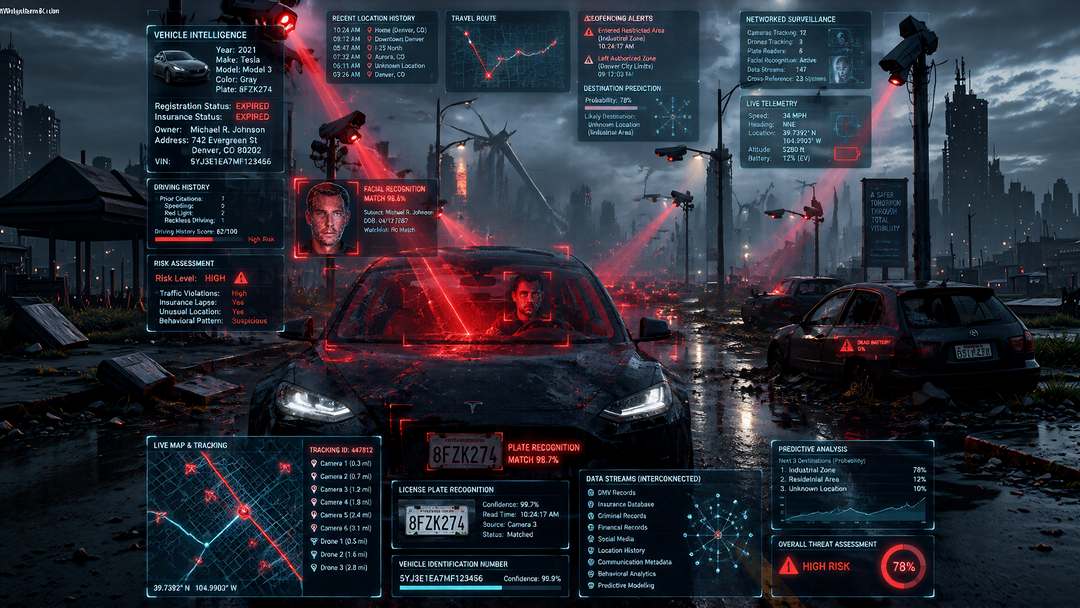
For most drivers, a commute, shopping trip, or visit to another city feels like a private and ordinary part of daily life. Increasingly, however, those movements are being captured, recorded, stored, and analyzed through automated license plate reader systems such as Flock cameras. What begins as nothing more than driving down a public road can become part of a criminal investigation, a surveillance database, or a prosecutor’s timeline.
In Michigan and across the country, Flock Safety cameras are changing how law enforcement gathers evidence. Supporters view the technology as an effective crime-fighting tool. Critics warn that it is creating a surveillance network capable of tracking the routine movements of law-abiding citizens.
How Flock Cameras Are Used in Criminal Investigations
Flock cameras are designed to capture license plates, vehicle characteristics, timestamps, and locations whenever a vehicle passes a camera location. Law enforcement agencies can then search that information to identify where a particular vehicle was observed and when.
In Michigan investigations, automated license plate reader data is commonly used to:
- Place a vehicle at a specific location and time.
- Corroborate investigative timelines.
- Identify vehicles connected to criminal investigations.
- Support traffic stops based on alerts or investigative leads.
- Build circumstantial cases around a vehicle’s travel history.
The key limitation is equally important.
A camera identifies a vehicle, not the person driving it.
In DUI, drug, and other criminal cases, prosecutors must still prove that the defendant was operating or controlling the vehicle. A license plate hit may place a vehicle at a location, but it does not automatically establish who was behind the wheel.
The Tewolde Lawsuit and the Fight Over Flock Records
Michigan’s debate over Flock surveillance reached public attention through litigation involving Genesee County and Kettering University student Josh Tewolde.
The dispute arose after requests were made under Michigan’s Freedom of Information Act seeking records related to the county’s Flock camera program. Among the requested records were camera locations, audit logs showing who accessed the system, and information concerning scans involving a particular vehicle.
What might have remained a relatively obscure surveillance system suddenly became the subject of a broader debate about transparency, accountability, and public oversight.
The case raises questions extending far beyond public records:
- How often are Flock databases searched?
- Who has access to the information?
- What standards govern those searches?
- How long is the data retained?
- Are audit logs available to verify appropriate use?
- Can investigators selectively rely on favorable vehicle sightings while ignoring information that may help a defendant?
For criminal defense attorneys, answers to those questions may become critical discovery issues whenever Flock data plays a role in a prosecution.
When Legal Michigan Travel Becomes Suspicious Elsewhere
One of the most controversial aspects of Flock surveillance is that lawful conduct can become part of a criminal suspicion narrative.
Michigan’s legal cannabis market provides a good example.
Activities that are completely lawful inside Michigan, including visiting a licensed dispensary, can attract attention in jurisdictions where marijuana remains more heavily restricted.
Investigators in other states have used Flock data to identify vehicles making repeated trips into Michigan and then returning home. Those travel patterns can become part of an affidavit, investigation, or probable-cause argument, even though the underlying activity may be entirely lawful under Michigan law.
The concern for civil liberties advocates is obvious.
The vehicle is not being flagged because police witnessed criminal conduct. Instead, the inference often arises from where the vehicle traveled and what investigators believe that travel might suggest.
The result is a world in which driving to a lawful destination may later appear in a law enforcement database as a potentially suspicious activity.
Why Michigan Drivers Should Care
Many Michigan residents assume that if their conduct is legal under Michigan law, there is little reason to worry about surveillance technology documenting it.
That assumption may not hold true.
Modern license plate reader systems create extensive travel histories. Those histories can reveal:
- Frequent visits to certain businesses.
- Travel patterns across state lines.
- Attendance at medical facilities.
- Visits to political or advocacy events.
- Associations between multiple vehicles observed in the same locations.
While a single camera hit provides limited information, hundreds or thousands of hits over time can paint a detailed picture of a person’s movements.
That is why many privacy advocates argue the technology raises concerns that extend well beyond traditional law enforcement investigations.
Flock Cameras and Michigan’s Cannabis Industry
The intersection of surveillance and cannabis regulation has already become a real issue within Michigan.
Some municipalities have explored or implemented requirements involving camera systems and law enforcement access as part of cannabis licensing and security programs.
These disputes highlight a larger question: should participation in a legal, state-regulated industry require businesses to provide enhanced surveillance access to government agencies?
Supporters argue such measures improve public safety and deter criminal activity.
Critics respond that they can create a form of industry-specific surveillance that would be unacceptable if applied to most other lawful businesses.
The debate illustrates how surveillance technology is increasingly becoming embedded not only in policing, but also in licensing and regulatory frameworks.
The Constitutional Questions Are Growing
As Flock networks expand, legal challenges are beginning to focus on privacy and constitutional protections.
One major issue is whether long-term license plate tracking resembles the type of location monitoring that courts have increasingly scrutinized in the digital age.
A single camera exposure is relatively limited. Continuous tracking over weeks or months is different.
When investigators can reconstruct where someone has traveled, where they regularly go, and whom they frequently encounter, courts may eventually be asked whether that level of surveillance requires greater constitutional protections.
Another area of litigation focuses on how vehicle information is connected to personal identifying information and whether those practices comply with federal privacy laws.
These questions remain active and evolving in courts around the country.
What a Flock-Based Investigation Might Look Like
A typical investigation involving Flock technology may unfold in a relatively simple manner.
Investigators identify a vehicle of interest.
The vehicle’s plate is entered into a license plate reader system.
Search results return past sightings from multiple camera locations.
Investigators use those sightings to create a timeline, identify travel patterns, or establish connections between locations.
That information then becomes part of an affidavit, investigative report, traffic stop, search warrant application, or criminal prosecution.
At each stage, defense attorneys may challenge both the accuracy of the underlying data and the conclusions investigators draw from it.
After all, a camera hit only proves that a vehicle passed a camera.
It does not automatically prove who was driving, why the vehicle was there, what occurred afterward, or whether any crime was committed.
When “Just Driving” Becomes Evidence
That may be the most important lesson of the Flock debate.
The issue is not simply whether automated license plate readers help solve crimes. In many cases, they undoubtedly do.
The larger question is what happens when routine, lawful behavior becomes part of a searchable surveillance record.
A trip to work. A drive across town. A visit to a friend. A stop at a Michigan dispensary. A weekend road trip.
In a world increasingly covered by automated license plate readers, even ordinary travel may someday become evidence.
And that raises questions about privacy, transparency, and constitutional limits that courts are only beginning to address.
Flock Camera Locations in Michigan — Live MI ALPR Map | Flock Camera Locations
Flock Camera Map — Live Interactive Map of Flock Safety Cameras | Flock Camera Locations