
Summary
The Michigan Supreme Court is weighing a pivotal question: Can courts legally prohibit adults from using marijuana while on probation, even though recreational cannabis has been lawful statewide since 2018?
The issue arises from People v. Danielle Heaven‑Leah Hess, a case that challenges whether probation conditions can override rights granted under the Michigan Regulation and Taxation of Marihuana Act (MRTMA). The Court heard oral arguments on March 11, signaling that a definitive statewide rule may soon be established.
Background
Danielle Hess pleaded guilty in 2021 to third‑degree retail fraud and received one year of probation. Her probation order barred marijuana use and required drug testing. In 2022, she twice tested positive for cannabis, resulting in two probation violations. After the second violation, Hess asked the district court to amend her probation terms, arguing that MRTMA protects lawful adult use and that courts cannot impose conditions that conflict with state law. The lower courts disagreed, prompting the appeal now before the Michigan Supreme Court.
Opinions and Arguments
Supporters of Hess’s position argue that MRTMA expressly shields adults from penalties for lawful marijuana use, and probation conditions should not function as a back‑door criminalization of conduct voters legalized. They contend that unless marijuana use directly relates to the underlying offense or poses a demonstrable risk, courts should not restrict it.
Opponents maintain that probation is a conditional privilege, not a right, and judges must retain discretion to impose behavioral restrictions that promote rehabilitation, compliance, and public safety. They argue that marijuana use may interfere with treatment, supervision, or accountability, giving courts legitimate grounds to prohibit it.
What’s at Stake
The Court’s ruling will determine whether Michigan judges may continue imposing blanket marijuana bans on probationers—or whether such conditions violate MRTMA. The decision will affect thousands of individuals under supervision and could reshape probation practices statewide. It may also clarify the broader tension between voter‑approved cannabis legalization and judicial authority to regulate conduct during probation.
In Closing: Who, What, When, Where, Why, and How
-
Who: The Michigan Supreme Court; defendant Danielle Heaven‑Leah Hess; lower courts that upheld the probation condition.
-
What: A legal challenge to probation terms prohibiting marijuana use despite statewide legalization.
-
When: Oral arguments were heard March 11; the underlying probation violations occurred in 2022.
-
Where: Michigan Supreme Court, reviewing a case originating from a Michigan district court.
-
Why: Hess argues that MRTMA protects adult marijuana use and that probation conditions cannot contradict state law.
-
How: After two positive drug tests, Hess sought to amend her probation terms; lower courts denied relief; the issue is now before the state’s highest court for a definitive ruling.
Relevant Laws and References
-
Michigan Regulation and Taxation of Marihuana Act (MRTMA) – Legal framework for adult‑use cannabis
-
People of MI v. Danielle Heaven‑Leah Hess Court of Appeals Opinion
-
Michigan Court Rules on Probation Conditions – Judicial authority and statutory limits
FAQs
Q: What is the central legal question in this case?
A: Whether Michigan courts can prohibit marijuana use as a condition of probation when MRTMA legalizes adult recreational use.
Q: Did the lower courts support Hess’s argument?
A: No. The district court and subsequent appellate review upheld the probation condition, prompting the appeal to the Michigan Supreme Court.
Q: Does MRTMA explicitly address probation conditions?
A: MRTMA protects adults from penalties for lawful marijuana use, but it does not expressly define how those protections interact with judicial supervision.
Q: Could the ruling affect all probationers in Michigan?
A: Yes. A statewide decision would set binding precedent for all courts imposing probation conditions.
Q: Was the probation condition voted on or approved by any legislative body?
A: No. The condition was imposed by the sentencing judge as part of Hess’s individual probation order; the Supreme Court is now reviewing whether that judicial authority conflicts with MRTMA.
Fraud Fatigued?
- 24% tax on weed
- 52 cents per gallon tax
- fraud
- more fraud
- more fraud
- more fraud
- more fraud
- Detroit judge, 3 others charged in alleged scheme to steal thousands from vulnerable and incapacitated people
- Ex- (Who cares Red or Blue) Party treasurer charged with embezzling from vulnerable adult
- and more fraud
- Tax Tax Tax
-
MSN-Desperate Kathy Hochul begs wealthy New Yorkers to come back
- California’s ‘Bridge to Nowhere’ has cost you $77M so far — but expert says that’s just the start
Here’s something else
- The WasteWatcher (Citizens Against Government Waste)
- Michigan gets a new state budget: Winners, losers in the $81B deal


As always… Follow the money.
More Posts

How Legal Michigan Cannabis Becomes Illegal in Ohio
Or Borders Matter... For years, Michigan residents have grown accustomed to a simple reality:...
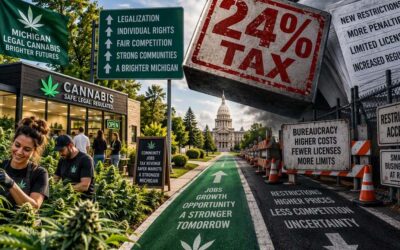
Michigan’s 24% cannabis tax is about more than just a really bad idea
Michigan's 24% wholesale cannabis tax is about more than just being a really bad idea. For...

Michigan Flock Cameras – How Your Daily Drive Becomes Police Data
For most drivers, a commute, shopping trip, or visit to another city feels like a private and...

The Magical THC Detector
THC Detection Research (2021–2026): What the Latest Science Means for DUI‑Marijuana EnforcementKey...

The Michigan Medical Marijuana Program (MMMP)
Michigan Medical Marijuana Program (MMMP)Overview Michigan legalized medical marijuana in 2008...

Ann Arbor’s 2026 Hash Bash Secures Permit
Summary Ann Arbor’s iconic Hash Bash will return to the University of Michigan Diag in 2026 after...